Support from National medicines Agencies for the development of innovative medicines at the National levels
Introduction
National Medicines agencies have created a diverse set of National support schemes to facilitate the development of medicines through early interactions with medicine developers. These are available in most of the European Economic Area (EEA) and European Union (EU) Member States. These mechanisms complete the set of schemes and procedures established at the European Level and those involving several competent authorities. They enable early dialogue at the National level for innovative medicines for preparing Clinical trials and future marketing authorisation applications.
Existing National mechanisms for early interaction are quite similar across the EU. However, the names of those available mechanisms can differ from country to country. Despite National differences on the availability and content of existing mechanisms, parallels can be drawn on the basis of their common characteristics where those mechanisms exist. Beyond their identification, we have divided the various procedures available in EEA countries into two categories in order to streamline and clarify them:
Advice Category : This category refers to advice given at the national level. It includes scientific and/or regulatory advice as well as other types of advice which are formalised and, in most cases, paid services. For scientific and/or regulatory advice, the procedures are generally built as the EMA’s scientific advice procedure, even though some specificities or minor differences can exist.
Meeting Category : The meeting category includes three different types of meetings: informal discussions, Portfolio meetings and Pre-submission meetings. These are mostly free of charge. The process is less formal, than the procedures in the advice category.
It is important to underline that each country has its specificities. Some offer many different schemes and services as they devote considerable effort to supporting and fostering the development of innovative medicines. Most countries have a procedure for scientific advice, and some have also one (or more) meetings’ type procedure(s).
Developers can enter into early interaction with a National Medicines Agency, through the use of one or several of the schemes available in the targeted country. The choice of the scheme to enter should depend on the needs of developers, and on the budget they can allocate to these interactions with regulators.
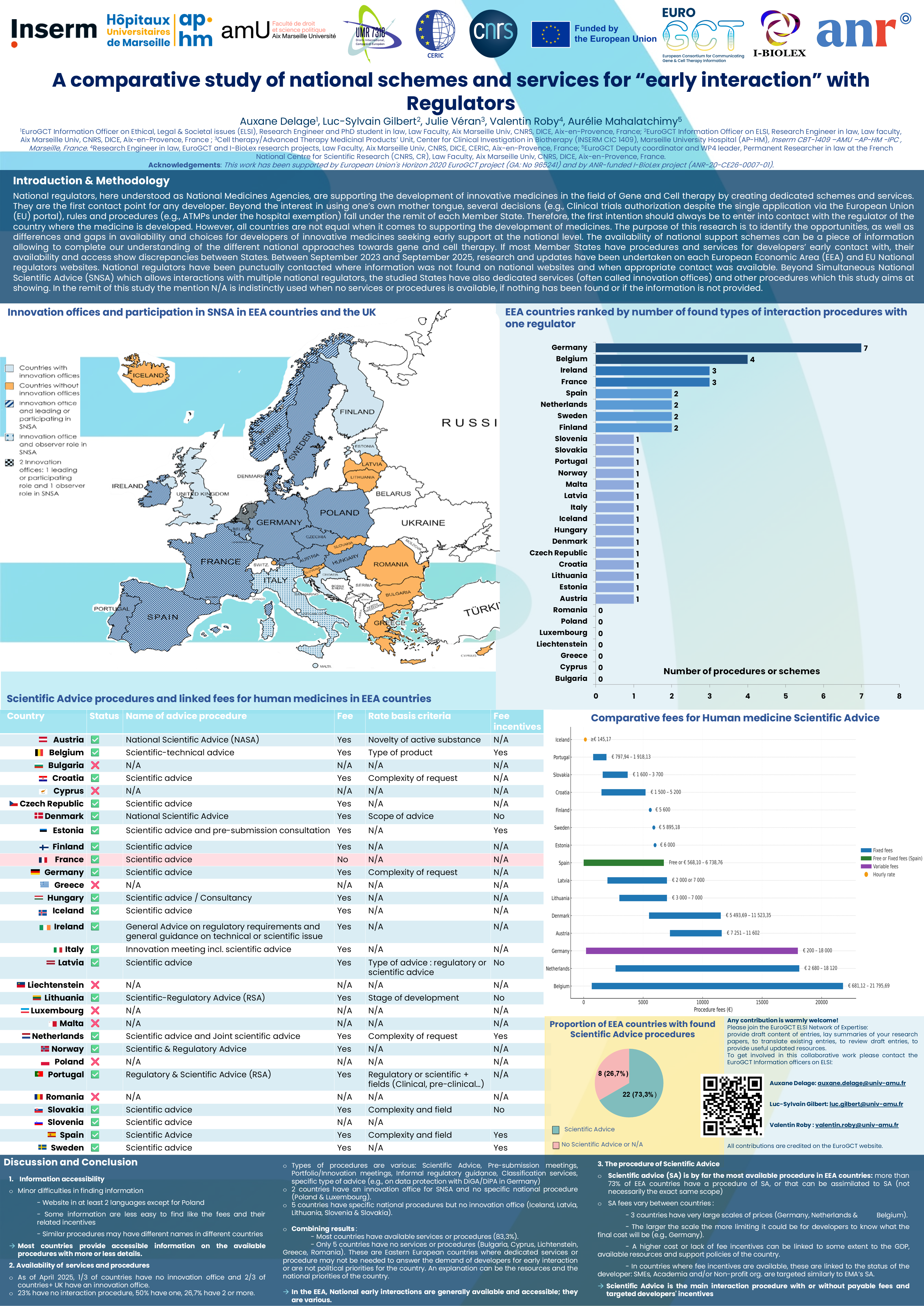
A. DELAGE, L.-S. GILBERT, J. VERAN, V. ROBY, A. MAHALATCHIMY, A comparative study of national schemes and services for “early interaction” with Regulators, ESGCT 2025, 7-10 October 2025, Sevilla, Spain
Main actors
Innovation office: Innovation offices are a service provided by National medicines Agencies. They centralise the services and procedures available to developers of innovative health products (such as innovative medicines), including the ones designed to facilitate early interactions with regulators. Their aim is to help developers navigate the different support schemes that are available, and choose the right one according to their specific need. Innovation offices are a way of targeting and answering developers needs and to give them the support they need to bring new innovative medicines to the market. Examples of schemes and procedures for which innovation offices provide guidance are: the scientific advice procedure at the national level, or the simultaneous national scientific advice (SNSA) procedure, where available. It is important to underline that not all countries in the European Economic Area (EEA) have such a designated entity to assist developers in obtaining the information they need when creating a new medicine. The list of existing Innovation offices in the European Economic Area (EEA) countries is available on the EuroGCT Actors and Networks database.
Medicines’ developers: Actors of the health sector finding new treatment options and bringing new medicines to the market, after authorisation. Medicine developers are the target of early interaction with regulators such as the European Medicines Agency (EMA). Medicines’ developers can be academia industry, or non-profit organisations although they are generally from the industry sector (mainly big pharma but also SMEs) given the resources necessary for the commercialisation of medicines.
National medicines Agencies : At the national level, National medicines Agencies are the regulator in charge of promoting human health and ensuring the safety of medicines. They are the public body responsible for regulating medicines under the authority of the ministry of health in most countries. National medicines agencies evaluate, authorise, regulate and control human medicines as well as health in the realm of the State. A comprehensive list of National Competent Authorities in EU Member States can be found in EuroGCT’s Actors and Networks database.
Regulators: Entities designated by law for authorisation, approval, evaluation, oversight, surveillance, and/or adoption of guidance in a specific field. In the context of gene and cell therapies, multiple regulators can be involved throughout their development cycle: medicines agencies (European or National), Health Technology Assessment bodies, research funding and authorisation authorities, patent offices, ethics bodies/committees, notified bodies (in the context of combination with medical devices), data authorities, etc. (From EuroGCT’s Glossary of terms)
Seeker of interaction: The medicine developer interested in a specific procedure or service established to foster early interactions between Competent authorities and stakeholders. The purpose of the interaction is to facilitate the development of future marketable medicines.
Definitions
National Scientific Advice: Scientific advice is always a formalised process as long as a specific procedure has to be followed in order to benefit from this type of early interaction. It includes a specific timeline, a specific scope of questions and of the advice to be given (regulatory and/or scientific questions/advices), where applicable the type of product developed, and most of the time, a fee. The fees can sometimes be waived, especially for academia and non-profit developers, or SMEs.
The Scientific procedure can take different names depending on the country concerned. Scientific advice is not necessarily an early interaction: for example, scientific Advice can sometimes be given for a new indication of an already authorized medicine.
Practical steps
Note: Information, links and prices are accurate at the time of research in January 2026. New information and procedure were found between October 2025 and the end of January 2026 enabling a thinner analysis of data and adjustments to the results presented at the ESGCT Congress in October 2025. Also, the prices may change from what is announced. For instance, in the Netherlands, fees changed between 2025 and 2026, which explains the difference between the data in the Poster presented at ESGCT and those in this table below.
Abbreviations found in the following tables,
– : Information does not exist, or cannot be found for an existing procedure;
ATU: Temporary use authorisation (translated from the French “autorisation d’utilisation temporaire”) ; DKTK: German Cancer Research Center ; DZIF: German Center for Infection Research ; CTA : Clinical Trials Application; MA : Marketing Authorisation; ATMP : Advanced Therapy Medicinal Product
I. Advice procedures
1. Advice procedures in EU countries
Most EU countries have advice procedures. These include the following types:
For medicines : Scientific advice, Classification of product (Ireland)
For Medical devices (and combination products) : Consultancy and Digital applications (Germany).
Twenty-five advice procedures were identified in nineteen different EU countries, showing a wide variety of available advice procedures across the European Union.
Scientific advice (and its equivalent for medical devices) is the main type of advice procedure used in EU countries. Twenty different Scientific advice procedures have been identified at the time of research. Other types of advice procedures like Classification advice or Digital Health Applications (DiGA)/ Digital Care Applications (DiPA) consultations are country specific.
Advice procedures can be used for all types of medicines (meeting eligibility criteria), including ATMPs. Some countries (Norway, Spain) explicitly mention gene and cell therapy, highlighting the specific advantages that these interactions may offer for gene and cell therapy, and the particular attention the Agency may pay to these types of therapies. When nothing is explicitly specified, it does not mean that these procedures are not relevant to these therapies.
Table 1 below provides an overview of the advice procedures and their main elements that we have identified in EU countries.
Table 1 : Overview of Advice procedures in EU countries
For pharmaceutical company, for sponsor of clinical studies, for any entity marketing authorisation applicant
Early stages of device development (medical devices scope)
For pharmaceutical, pre-clinical, and clinical of medicinal product development
Written or Oral Scientific advice
Procedural-regulatory and scientific issues on requirements for pharmaceutical, pre-clinical, and clinical documentation and safety for medicinal products.
See link and application form for information on the steps and timeline of the procedure
At the time of research and based on the collected data, only Ireland appears to have a specific procedure in place to assist in the classification of medicinal products for human use.
The Irish Medicines Agency (HPRA) “offers a service to stakeholders to clarify the appropriate regulatory category for products that are borderline between human medicines, medical devices and other regulated products, such as cosmetics.”
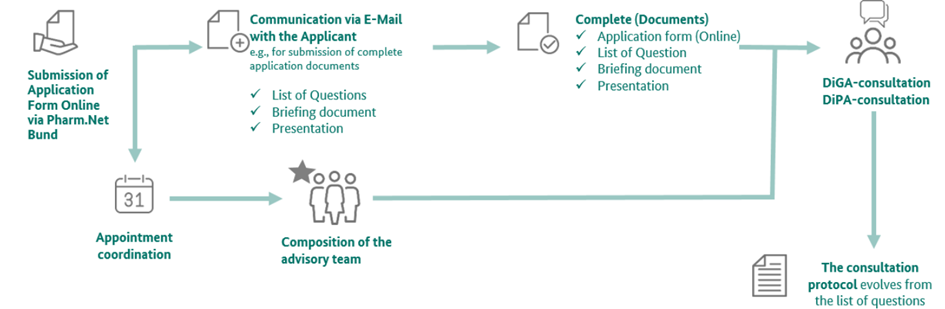
DiGA/DiPA consultations in Germany (for medical devices and combination products)
The German innovation office at the Federal Institute for Drugs and Medical Devices (BfArM) offers a specific pre-advice meeting (see below for more information on meeting procedures within the EU) and two types of advice procedures, called consultations. They are made for digital applications.
The two consultations are aimed at:
Digital health apps that can be prescribed to patients to help them treat with their condition (DiGA),
The healthcare applications designed to help healthcare providers manage patients and diseases (DiPA).
With the progress of new numerical technologies, new medical devices can be “apps on prescription”, they meet the definition and framework required to be authorised as medical devices and are part of the treatment of a disease.
Developers of such applications can ask for advice following the steps of the procedure below
2. Advice procedures in non-EU EEA countries (Iceland, Norway, Lichtenstein)
Most non-EU EEA countries have established advice procedures. In fact, two out of three countries do so (Iceland & Norway). No information was found for Lichtenstein leading to the conclusion, there is no advice procedure in that country.
Please find below, in Table 2, the main elements gathered from the relevant websites for countries that have an advice procedure in place.
Table 2 : Overview of Advice procedures in non-EU EEA countries
All phases of lifecycle (medicinal products and medical devices)
ATMP is an area of expertise
Timeline not specified
—
II. Meeting procedures
National medicines agencies in several EU countries have set up less formal procedures. These may be requested without an application form, except in the rare instances the procedure is part of an advice procedure (Sweden). They are designed to help developers ask questions about innovative medicines’ development before seeking advice, or to avoid resorting to formal advice, such as scientific advice. Some countries (e.g., Spain or Sweden) do not distinguish between these procedures and requests for scientific advice (advice procedure). Other countries do distinguish between the two.
These types of procedures are usually free of charge. These specific ways of interacting with National regulators can be classified into three different categories, based on specific criteria that highlight similarities between different schemes in different countries:
Informal discussion: Some schemes are designed to enable developers to enter into early interaction with a National competent authority in order to obtain, in an informal setting (written or oral), answers to certain questions they may have. These meetings (or written answers) would not necessarily be preparatory to a request for Scientific advice, but would serve solely to answer certain questions on general regulatory or scientific requirements.
Portfolio meeting : Meeting for strategic planification.
Pre-submission meeting: Preparatory meeting for a request for Scientific advice.
Table 3: Comparative overview of existing meetings procedures across EU countries
Country
Informal discussion
Pre-advice / Pre-submission meeting
Portfolio meeting
Belgium 🇧🇪
✅ Project-info meetings
✅ Pre-submission meetings
✅ Portfolio meetings
Finland 🇫🇮
✅ Informal regulatory guidance
—
—
France 🇫🇷
—
✅ Pre-submission meeting
✅ Development portfolio presentation for strategic planification
Germany 🇩🇪
—
✅ Kick-off meetings (DKTK/DZIF) ;
✅ Pre-advice meetings (BfArM / PEI) ;
✅ Pre-submission meetings (centralised procedure)
✅ Portfolio meetings
Ireland 🇮🇪
✅ Innovation Office queries
✅ Pre-submission meeting
Malta 🇲🇹
✅ Informal meetings (Innovation support – MMA)
—
—
Spain 🇪🇸
—
✅ Pre-submission meetings
—
Sweden 🇸🇪
—
✅ Pre-submission meeting
—
Few countries have established meeting procedures; they are fifteen such procedures in seven different countries. Among these countries Italy and Malta do not have advice procedures, unlike the other countries which have established a meeting procedure. Therefore, most countries with a meeting procedure also provide one or more advice procedure.
Meeting procedures can be used for all types of medicines, including ATMPs. Some countries (Malta & Italy) explicitly mention gene and cell therapy, highlighting the specific advantages that these interactions may offer for gene and cell therapy, and the particular attention the Agency may pay to these types of therapies. When nothing is explicitly specified, it does not mean that these procedures are not relevant to these therapies.
Table 4 below provides an overview of the Meetings procedures and their main elements that we have identified in EU countries
Table 4 : Overview of Meetings procedures in EU countries
For SMEs, academic research centres, spin-offs and academic hospitals
Very early-stage clinical research project
Granted depending on eligibility and expert availability (no fixed timeline stated)
On general regulatory requirements/ procedural steps when initiating a medicine development project, to identify any future scientific, technical and regulatory hurdles
Strategic pipeline discussion on company, activities, medicine development pipelines, therapeutic areas, the latest scientific developments and challenges
Request by written request to [email protected] (timing by agreement)
Pre-submission meeting possible if MPA is appointed rapporteur/co-rapporteur
Pre-submission meeting Possible request if the agency is appointed rapporteur or co-rapporteur. A pre-submission meeting is an opportunity to present your products and to discuss regulatory matters.
No scientific questions.
The same application form as for scientific advice should be used for pre-submission meetings.
For the other countries, namely Bulgaria, Cyprus, Greece, Luxembourg, Poland, Romania and Liechtenstein, no information was found. It seems likely there are no established procedures in these countries, or at least none has been found.
Challenges
Because of a lack of harmonisation, the services and procedures or types of advice available vary from country to country. The procedure that developers require may not be available in their country.
The vocabulary used by Competent authorities may differ from country to country. Even if the schemes are similar, they may not have the same exact name.
Finding the information on the existing schemes is also a challenge in itself. Some information is clearly stated on websites, but in other countries, contradictory information or outdated information may be found. The multiplicity of webpages can make searching for early interactions more difficult. The tables provided here will therefore facilitate access to information, particularly for developers seeking comparative information on opportunities for interaction with regulators at national level in several EEA countries.
The language barrier could also be a challenge when trying to get information on several EEA countries. However, there appears to be a genuine effort to provide information in English as well as in the country's national language.
The fees to enter the available schemes and procedures vary a lot between countries. While some countries offer specific fee waivers and incentives for early interactions, this is not the case in most countries. The amount of the fees can be a real obstacle for some medicine developers who may need advice but do not have the necessary funds to pursue it. The poster presented and the tables indicate the prices of the various procedures and some of the available fee waivers.
Opportunities and incentives
The research highlighted a number of different procedures across Member States. Therefore, developers have many ways to engage in early dialogue with competent authorities across the European Union. The schemes and procedures available are opportunities in themselves, especially when they are free of charge.
Acknowledgements
Published: 03/02/2026
Authors:
Auxane Delage, EuroGCT information officer on Ethical, Legal and Societal Issues
Aurélie Mahalatchimy, EuroGCT WP4 Convenor, UMR 7318 DICE CERIC, Aix-Marseille University, CNRS, Aix-en-Provence, France