Medicine pricing and reimbursement in France: introduction, definitions, and key players
Introduction
After obtaining marketing authorisation (MA), an MA holder (usually a company) can request an assessment of its medicine to determine its pricing and reimbursement in France. France has a fairly lengthy process for reaching a price agreement between the manufacturer and the national competent authority. Nevertheless, the existence of authorisation procedures tailored to Advanced Therapy Medicinal Products (ATMPs) has already enabled several ATMPs to access the French market.
The French system is based on registration on positive lists, meaning that medicines included on these lists are covered by the national social security system. ATMPs are included in the list of medicines available in healthcare establishments, i.e. hospitals. When certain therapeutic indications for ATMPs are innovative, they are generally included in the ‘additional list’, i.e. the list allowing reimbursement in addition to hospitalisation fees.
Main Actors
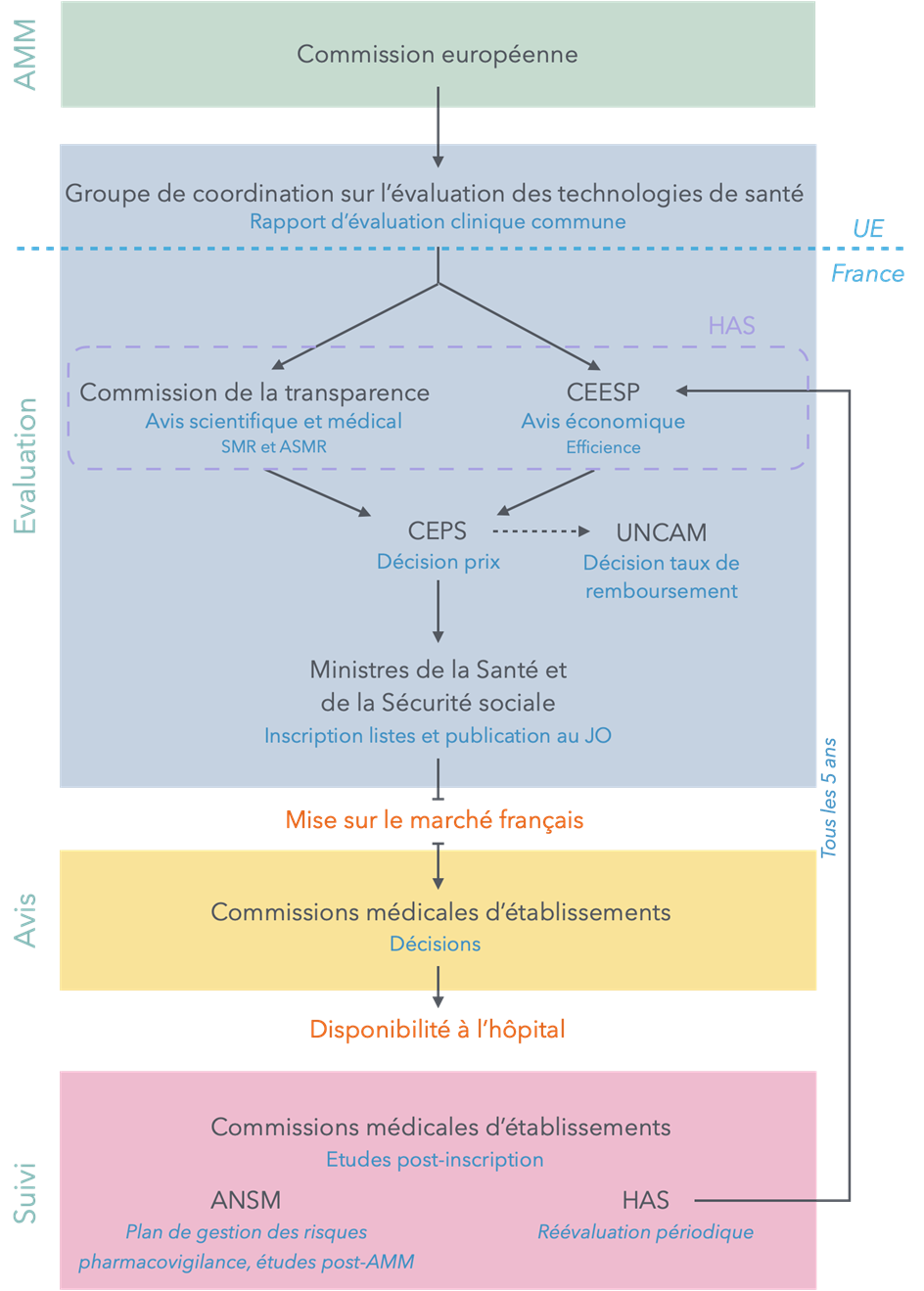
The Member States Coordination Group on Health Technology Assessment (“HTA Coordination Group”), composed of representatives of Member States (in particular from health technology assessment authorities and bodies), is responsible in particular for joint clinical assessments (subgroup for this purpose) of ATMPs from 1st January 2025.
The Haute Autorité de Santé (HAS) is the national independent public authority responsible for evaluating medicines, medical devices and professional procedures to determine pricing and reimbursement decisions in France. It also issues recommendations on good professional practice and plays a role in measuring and improving the quality of care and patient safety in healthcare establishments, general practice and social and medico-social structures.
The Transparency Commission: (CT, from “Commission de la Transparence”) is a scientific body of the HAS composed of doctors, pharmacists, methodologists, medical and public health assessment experts, and members chosen from among the members of an association of patients and users of the healthcare system. Independent of manufacturers and payers, it is responsible for advising the public authorities on the pricing and reimbursement of medicines. In this respect, it evaluates, indication by indication, medicines having obtained marketing authorisation, when the laboratory marketing them requests their inclusion on the list of reimbursable medicines. Its assessment is based on two criteria: the medical service provided, which informs decisions on reimbursement, and the improvement in the medical service provided, which informs decisions on pricing. (Article L162-17 du Code de la sécurité sociale and Article L5123-2 du Code de la santé publique, in French)
The Economic and Public Health Assessment Committee (CEESP, from “Commission d’Évaluation Économique et de Santé Publique”), composed of experts selected for their expertise in the fields of health, economic assessment and public health, and members chosen from among the members of an association of patients and users of the health system, is a specialised committee affiliated with the HAS in France. It is responsible for producing medico-economic opinions on healthcare procedures, health products and services, determining the most efficient therapeutic strategies, and issuing recommendations accordingly. These analyses and assessments are intended for innovative healthcare products and technologies that are considered innovative and likely to have a significant impact on National health insurance expenditure. Taking into account the price claimed by the company, the CEEPS assesses the efficiency and financial impact of the medicine on public expenditure, with a view to informing decisions on the pricing of medicines and not those relating to their reimbursement.
The Economic Committee for Health Products (CEPS, from “Comité Économique des Produits de Santé”) is a French interministerial body mainly responsible by law for setting prices of medicines and tariffs for medical devices for individual use covered by compulsory National health insurance. The latter will negotiate a conditional price based on conventional indicators defined in the framework agreement, with the implementation of post-marketing surveillance, the results of which are expected to provide sufficient clinical data for a longer-term evaluation in a real practice setting. As part of these tasks, the CEPS may enter into agreements with companies or groups of companies on the price of medicines and its evolution, on discounts, on companies' commitments regarding the proper use of medicines and sales volumes, and on the terms and conditions for companies' participation in the implementation of ministerial guidelines.
The National Union of Health Insurance Funds (UNCAM, from “Union Nationale des Caisses d'Assurance Maladie”) is the French body that brings together representatives of the general scheme and the agricultural scheme. Its role is to coordinate the action of the national funds in managing health insurance and to establish partnerships with healthcare professionals and supplementary social protection organisations. Its other tasks include conducting conventional policy, defining the scope of services eligible for reimbursement, and setting the rate of health coverage. With regard to medicines, its competence covers reimbursement rates.
The ministries responsible for health and social security in France: the minister responsible for health has the final say in the health technology assessment process. All opinions and data obtained through the various HAS and CEPS committees are used to decide whether or not to include a medicine intended for hospital use on the ‘additional list’ (defined below in the “Practical steps” section). The Ministry of Health is also responsible for deciding whether or not to reimburse a medicine. If the decision is to reimburse, the CEPS is then asked to negotiate the price.
The final decision to include a medicine in the reimbursement scheme is the responsibility of the ministers responsible for health and social security and is published in the Official Journal of the French Republic.
If a medicine is not (or not fully) reimbursed by the compulsory National health insurance, it may be reimbursed by supplementary health insurance bodies.
Hospital medical commissions, known as “Establishment medical commissions”, operate at local level in each hospital in France. They are responsible for deciding which medicines are available in the hospital's internal pharmacy, based on the list of medicines authorised for use by the Ministries of Health and Social Security.
Les Entreprises du Médicament (Leem): Leem is the professional union for pharmaceutical companies operating in France. It has more than 280 member companies, 50% of which are VSE/SMEs, engaged in research and development, manufacturing, operation and distribution of medicines for human use.
The Conventional Policy Steering Committee (CPPC, from “Comité de Pilotage de la Politique Conventionnelle”), composed of representatives from CEPS and Leem, addresses “any subject that contributes to conventional medicine policy and ensures its implementation and monitoring.” (More information on its composition, missions, meetings and technical groups can be found in Article 1 of the 2021-2024 Framework Agreement, available here in French)
Applicant: Often from the pharmaceutical industry, the legal entity that applies for its medicine to be included on the list of reimbursable medicines.
Marketing authorisation holder: The legal entity holding a marketing authorisation, obtained via the “centralised procedure” for ATMPs, to distribute and market an ATMP in the European Union.
The French National Agency for Medicines and Health Products Safety (ANSM, from Agence Nationale de Sécurité́ du Médicament et des produits de santé) is the national competent authority responsible for regulating medicines and health products in France. The ANSM ensures the quality, safety and efficacy of medicines, as well as their positive benefit-risk balance throughout their life cycle. It is included among the Main actors here, only due to its role in the early access procedure. (For more information, see: sante.gouv.fr, in French)
Figure inspired by the following sources: HAS, Le rôle de la HAS dans l’accès au remboursement des médicaments - Rencontre 28/03/2019, available here (in French) ; A. Mahalatchimy, A. Faulkner, Patients’ access to cell- based regenerative therapies: the reimbursement challenge in the UK and France, 5th Conference of the European Association of Health Law (EAHL), 1 – 2 October 2015, Prague, Czech Republic. (Poster); Assemblée Nationale, rapport d’information déposé en application de l’article 145 du Règlement par la commission des affaires sociales en conclusion des travaux de la mission d’information sur les médicaments et présenté par Mme Audrey Dufeu et M. Jean-Louis Touraine, Députés, 23 juin 2021, N°4275, p.27, available here (in French).
Definitions
The medical service provided (SMR, from “Service Médical Rendu”), an index assessed by the CT, provides information to the authorities responsible for approving medicines reimbursement on their clinical benefit. It is assessed on the basis of five determining factors: the efficacy and adverse effects of the medicine; its place in the therapeutic strategy (particularly in relation to other available therapies); the severity of the condition for which it is intended; the preventive, curative or symptomatic nature of the medicinal treatment; and its public health benefit. (Article R163-3 du Code de la sécurité sociale, in French)
There are four levels of SMR, which specify the contribution made by compulsory health insurance schemes. SMRs are classified as major or significant, moderate, low, and insufficient, corresponding to coverage rate by Social Security (compulsory health insurance) of 65%, 30%, 15%, and 0% respectively.
Improvement in medical service provided (ASMR, from Amélioration du Service Médical Rendu): Assessed by the CT, this index is used to evaluate the therapeutic progress of a new health product in a specific field in relation to the benefit/risk balance of existing treatments on the market. It participates in setting the price of reimbursable medicines. This comparative criterion is graded into five levels: major ASMR (I), significant (II), moderate (III), minor (IV) and non-existent (V) compared to what is already available. (Article R163-18 du Code de la sécurité sociale, in French).
The evaluation criteria used to determine the ASMR level of a medicine are the therapeutic efficacy, the level of reduction in adverse effects and ease of use. Its assessment is based on available comparative data in terms of efficacy and tolerance, namely the level of evidence, the extent of the effect and extrapolation to clinical practice, but also the therapeutic need and its coverage, as well as the impact on quality of life.
A medical economic analysis or assessment: A medical economic assessment is required for health products and technologies that are presumed to be innovative, i.e. those that offer a major, significant or moderate improvement in medical service rendered (ASMR), and when the medicine or technology is likely to have a significant impact on health insurance expenditure due to its price or its impact on the organisation of care, professional practices or methods of care. Thus, the impact is considered significant when it comes to ATMPs. The CEESP will determine the link between the cost differential and the estimated efficacy differential based on the price requested by the applicant and the target population claimed. The efficiency opinion issued will then be forwarded to the CEPS to assist in the price negotiation of these medicines. (R161-71-3 du Code de la sécurité sociale, in French)
Framework agreement: Framework contract between the Leem professional union and the CEPS. It defines the terms and conditions for negotiating the prices of medicines reimbursable by the National health service. The Leem-CEPS framework agreement, signed on 5 March 2021 for a period of three years (2021-2024), is applicable until 5 March 2025 (one-year extension). It addresses the challenges of access to ATMPs, specifying the rules relating to comparators, uncertainty, discounts and payment splits. More information on the framework agreement here, in French.
Contracts relating to real-life transposability: These “uncertainty management” contracts between a company and the CEPS commit the company to produce, by a specified date, the results of an analysis of the conditions of use of the medicine in real life in order to remove uncertainties, in exchange for the setting of specific pricing conditions. These contracts may be implemented in two cases:
Either the analysis of the Transparency Commission's opinion shows that a “variable of uncertainty may call into question the real-life transposability of decisive data in the pricing of a medicine”;
Or, “the performance of a product (efficacy, tolerance, efficiency) can be optimised by an action taken by the company” (examples: payment terms, compliance improvement measures). (Article 16 of the 2021-2024 Framework Agreement, available here in French)
The supplementary list: allows health insurance to cover, in addition to hospitalisation costs, certain therapeutic indications for medicines when they are innovative. This list, which specifies the indications concerned, is set by order of the ministers responsible for health and social security. (Article L162-22-3 duCode de la sécurité sociale, in French)
Fast-track pricing procedure. An innovative medicine of interest to public health which is awarded an ASMR of I to III or an ASMR IV subject to certain additional conditions by the CT may, once the opinion of the CEESP and the CT has been obtained, be eligible for a fast-track registration procedure: signing of a contractual amendment within 15 days of submission to the CEPS, and publication in the Official Journal within the strictest deadlines of the registration decree and the price opinion. (Article 14 of the Framework Agreement, in French).
Early access request: Since 1st July 2021, the HAS has been evaluating and authorising medicines that are the subject to a request for early access. Early access authorisation (AAP, from Autorisation d’Accès Précoce) is an exceptional derogation procedure that allows a medicine (for one or more indications) to be made available and covered financially before its reimbursement by the National Health Insurance.
Early access is a scheme that allows patients for whom therapy is no longer an option to benefit, on an exceptional and temporary basis, from certain unauthorised medicines for a specific therapeutic indication.
The conditions for access to this scheme are as follows:
Where a medicine has not yet been granted a marketing authorisation, its efficacy and safety are strongly presumed on the basis of the results of therapeutic trials;
The medicine must be intended for the treatment of serious, rare or debilitating diseases;
There is no appropriate treatment available;
Treatment cannot be delayed;
The medicine is presumed to be innovative, particularly in relation to a possible clinically relevant comparator.
The first criterion is assessed by the ANSM, the other four by the HAS.
Relevant literature
Albane, Degrassat-Théas. ‘La réforme des autorisations temporaires d’utilisation : concilier accès précoce à l’innovation et maîtrise des dépenses de médicaments Table analytique’. Revue Droit Sanitaire et Social, no. 4 (27 August 2021): 688-700.
Midy, Fabienne, Véronique Raimond, Clémence Thébaut, Cléa Sambuc, and Catherine Rumeau-Pichon. ‘Avis d’efficience relatifs aux produits de santé à la Haute Autorité de santé : bilan et perspectives’. Santé Publique 27, no. 5 (2015): 691-700. https://doi.org/10.3917/spub.155.0691.
Nabarette, Hervé. ‘Le processus d’implication des patients dans l’évaluation des technologies de santé à l’HAS’. Santé Publique 30, no. 6 (2018): 767-775. https://doi.org/10.3917/spub.187.0767.
Raimond, Véronique, Fabienne Midy, Clémence Thébaut, and Catherine Rumeau-Pichon. ‘L’évaluation économique des produits de santé innovants : quelle interprétation pour quel usage ?’ Revue française des affaires sociales, no. 3 (2016): 263-281. https://doi.org/10.3917/rfas.163.0263.
Trouvin, Jean-Hugues. ‘L’évolution de l’expertise sur le médicament’. Les Tribunes de la santé 27, no. 2 (2010): 61-78. https://doi.org/10.3917/seve.027.0061.
Wittwer, Jérôme. ‘Le rôle de l’évaluation économique dans la régulation des prix des médicaments innovants protégés par des brevets’. Revue française des affaires sociales, no. 3 (2018): 147-159. https://doi.org/10.3917/rfas.183.0147.