Regeneration: what does it mean, and how does it work?

Some parts of our bodies can repair themselves quite well after injury, but others don’t repair at all. We certainly can’t regrow a whole leg or arm, but some animals CAN regrow – or regenerate – whole body parts. So what can we learn from these regenerative animals? 

Regeneration and humans

Regeneration means the regrowth of a damaged or missing organ part from the remaining tissue. As adults, humans can regenerate some organs, such as the liver. If part of the liver is lost to disease or injury, the liver grows back to its original size, though not its original shape. Our skin is also constantly being renewed and repaired. Unfortunately, many other human tissues don’t regenerate. A goal in regenerative medicine is to find ways to kick-start tissue regeneration in the body, or to engineer replacement tissues. 

Regenerative animals

Axolotl

Other mammals are also capable of regeneration in some limited contexts, like humans. However, there are many animals that can regenerate complex body parts with full function and almost perfect form after injury, or even amputation. Invertebrates (animals without a spinal cord) such as the flatworm or planarian can regenerate their heads from a piece of their tail, their tails from a piece of their head – and both a head and a tail from a piece without either!  

Among vertebrates (animals with a spinal cord), fish can regenerate parts of the brain, eye, kidney, heart and fins. Frogs can regenerate the limb, tail, brain and eye tissue as tadpoles, but not as adults. And salamanders can regenerate almost any body part and organ -  including entire limbs, heart, tail, brain, lungs, eye tissues, kidney, brain and spinal cord throughout life. Scientists have learned a lot about regeneration by studying these animals.  

How do tissues regenerate after damage?

After amputation or injury, regenerative cells gather at the injury site in a structure called a blastema. There are different types of cells which can form the blastema and contribute to regeneration.  

Planarian or flatworm

Pluripotent stem cells

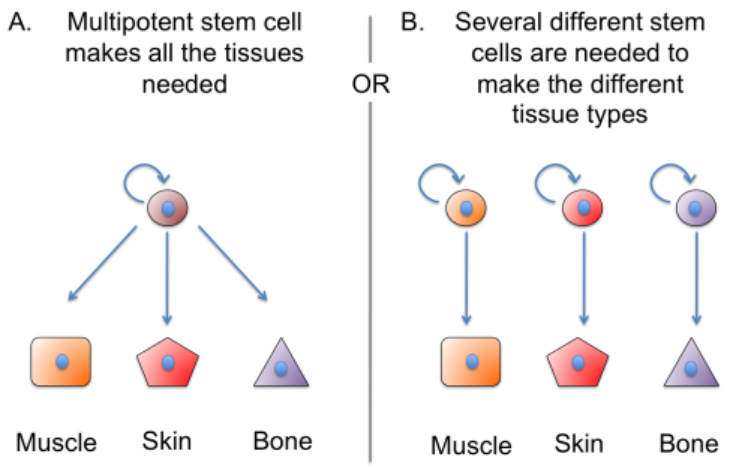
Pluripotent stem cells are capable of self-renewing, which means they can divide to produce more of themselves. They can also become any other different type of adult cell. The process of a stem cell becoming a specific type of adult cell is called differentiation. One a cell has differentiated, it stops dividing and self-renewing.  

Research on flatworms (planaria) showed that a single stem cell could regenerate a whole animal! This shows that adult planaria have pluripotent stem cells – cells that can make ALL the different cell types of the animal’s body. Several research groups are now studying how these pluripotent cells are controlled in the flatworm’s body so that they do not grow out of control or form tumours. 

Frog

Adult tissue stem cells

In some animals, each tissue – such as muscle, nerve, or skin – has its own set of adult tissue stem cells, that only make the different types of cells in that particular tissue. These restricted cells are called ‘progenitors’. These cells are also capable of self-renewing, but they are restricted in what type of cells they can become.  In other words, a muscle progenitor cell cannot make skin, and skin stem cells can’t make muscle. One example is the cells that regenerate a frog’s tail.  

Zebrafish

De-differentiated resident cells

In some cases, adult cells which have already differentiated can go back to being progenitor cells. From there, they are able to renew themselves or re-differentiate into adult cell types, but the type of cell they can become is still limited and tissue specific.  

This was first shown in axolotl limb regeneration, and has also been shown to happen in their spinal cord. This has also  been seen in heart regeneration in zebrafish, where a heart muscle cell called the cardiomyocyte divides to regrow missing heart tissue. This regeneration has also been shown to happen in newly born mouse hearts, but is quickly lost as the mice age. More research is needed to understand how differentiated cells can be made to turn back into progenitors and produce new heart tissue, and why human heart cells don’t have this ability.  

So - there are multiple ways in which regenerative animals regrow their tissues. Some animals use pluripotent stem cells, which can become every type of cell. Others use tissue-specific progenitor cells to regrow each different tissue type. These cells are either already present in the tissue, or are made from cells which have already differentiated that 'go back' to being progenitors. 

Multipotent or tissue-specific stem cells


How do scientists study regeneration?

Scientists wanted to investigate whether salamander regenerative cells were restricted to their original type, or could become any type of cell.  But how could they find out in the lab?

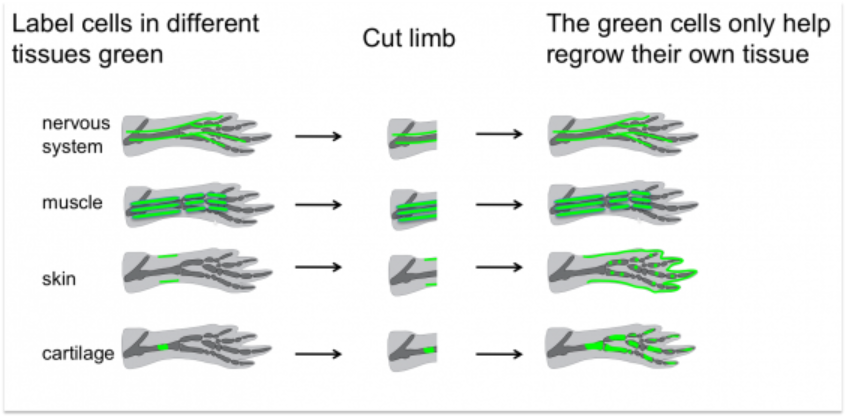
  • The researchers labelled cells in different tissues in the salamander, like muscle and skin, with a green fluorescent marker. 

  • They then cut off a limb and allowed it to regenerate.  

  • They tracked where the green cells moved to as they helped to regrow the new limb. They saw that the green cells only helped to regrow their own tissue type – muscle to muscle, skin to skin, for example.  

This allowed them to understand that in salamander limb regeneration, the cells are not pluripotent, but have a restricted, tissue-specific lineage.

Salamander regeneration diagram
Salamander limb regeneration: Salamanders use tissue-specific regenerative cells to regrow damaged limbs - each stem cell can only make cells belonging to one tissue.  

What are researchers working on?

Research in different regenerative animals has shown that there are various strategies for regenerating body parts built from multiple tissues, such as muscle, nerve and skin. If we understand the principles and molecules these animals use to regenerate adult tissues, could these lessons be applied to regenerating or engineering human tissue?

By learning more about the properties of stem cells that regenerate complex body parts, scientists are learning how injuries cause these stem cells to regenerate the missing part instead of just forming scar tissue. Future research may make it possible to apply this knowledge in new kinds of medical treatments. 

Czy uważasz informacje na tej stronie za pomocne? Przyślij nam swoje uwagi
-
Your feedback helps us keep EuroGCT online. Please can you take 30 seconds to answer these quick questions?
How would you rate your experience using EuroGCT.org today?
Poor
Great
Is the information on this website understandable?
Not at all understandable
Very understandable
Is the information on this website useful?
Not at all useful
Very useful
Is the website easy to use and navigate?
Not at all easy
Very easy
Why are you interested in gene and cell therapies and research?
CAPTCHA
To pytanie sprawdza czy jesteś człowiekiem i zapobiega wysyłaniu spamu.