Help and support
Help and support
- FAQ's
- Słownik
Gene and cell therapy-based medicines are often expensive and are currently more developed in the field of rare diseases. It may thus be more relevant to target several markets to develop commercially viable products for the benefits of more patients.
Considering the current trend of promoting early-contacts with regulators to facilitate the marketing authorisation of medicines, are there existing support-mechanisms for early contacts with both the EMA and FDA?
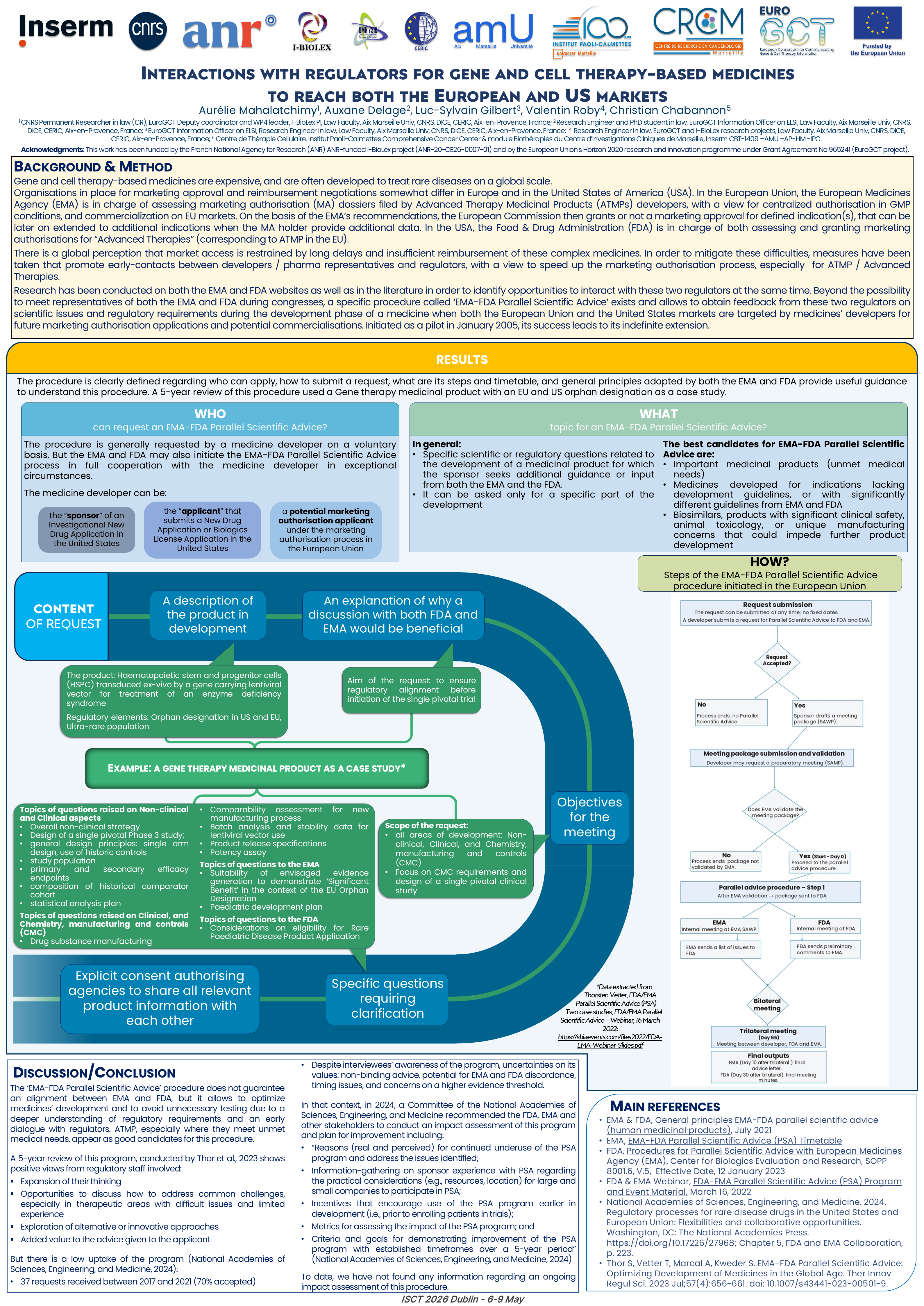
Research has been conducted on both the EMA and FDA websites as well as in the literature in order to identify opportunities to interact with these two regulators at the same time.
Beyond the possibility to meet representatives of both the EMA and FDA during congresses, it exists a specific procedure called ‘EMA-FDA Parallel Scientific Advice’ which allows to obtain feedback from these two regulators on scientific issues and regulatory requirements during the development phase of a medicine when both the European Union and the United States markets are targeted by a medicine’s developer for a future marketing authorisation application and a potential commercialisation. Initiated as a pilot in January 2005, its success leads to its indefinite extension.
The procedure is clearly defined regarding who can apply, how to submit a request, what are its steps and timetable, and general principles adopted by both the EMA and FDA provide useful guidance in order to understand this procedure. A 5-year review of this procedure used a Gene therapy medicinal product with an EU and US orphan designation as a case study.
The ‘EMA-FDA Parallel Scientific Advice’ procedure does not guarantee an alignment between EMA and FDA, but it allows to optimize medicines’ development and to avoid unnecessary testing due to a deeper understanding of regulatory requirements and an early dialogue with regulators. Gene and cell therapy-based medicines, especially where they meet unmet medical needs appear as good candidates for this procedure.
This work is part of the EuroGCT initiative: https://www.eurogct.org/
Aurélie Mahalatchimy, EuroGCT Deputy coordinator and WP4 leader; UMR 7318 DICE CERIC, Aix-Marseille University, Centre National de la Recherche Scientifique, Marseille, Provence-Alpes-Côte d’Azur, France
Auxane Delage, EuroGCT Information Officer on Ethical, Legal & Societal issues, Aix-en-Provence, France
Luc-Sylvain Gilbert, EuroGCT Information Officer on Ethical, Legal & Societal issues, Aix-en-Provence, France
Valentin Roby, EuroGCT information officer on Ethical, Legal and Societal Issues
Christian Chabannon, Professor of Molecular Biology, MD, Centre de Thérapie Cellulaire. Institut Paoli-Calmettes Comprehensive Cancer Center & module Biothérapies du Centre d’Investigations Cliniques de Marseille, Inserm CBT-1409 –AMU –AP-HM -IPC
To be cited as:
A. MAHALATCHIMY, A. DELAGE, L.-S. GILBERT, V. ROBY, C. CHABANNON, Interactions with regulators for gene and cell therapy-based medicines to reach both the European and US markets, ISCT 2026, 6-9 May 2026, Dublin, Ireland. (POSTER)